
After moving into a quiet neighborhood, a single father assumes the elderly man across the street prefers to be left alone—until his daughter learns what the light is for.
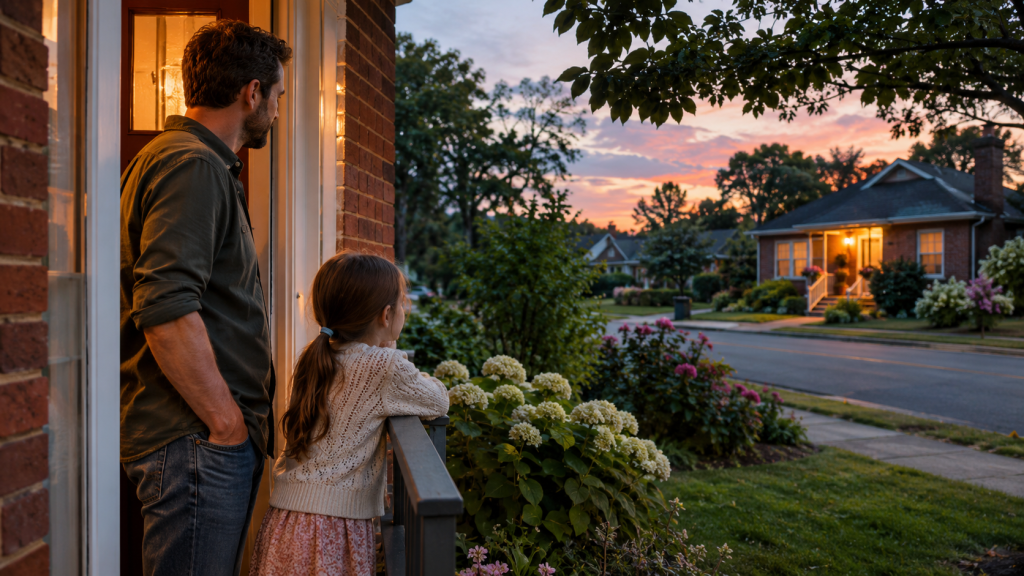
The porch light across the street came on at exactly 7:30 every evening. It was the first thing I noticed about our new neighborhood, and the last thing I saw before bed.
My daughter, June, noticed too. “Does Mr. Alvarez forget to turn it off?” she asked one night.
I told her I didn’t know. We had moved in six weeks earlier, and I had only exchanged a wave with the older man who lived in the brick house. He kept his curtains drawn and his front garden neat. I assumed he liked quiet.
Then June started leaving drawings on our windowsill: a yellow house, a blue cat, a family eating pancakes. She taped one to the glass facing the street. The next evening, the porch light blinked twice.
A signal in the dark
June decided it meant Mr. Alvarez had seen the picture. She made another drawing, this one of a little girl holding a star. At 7:30, the porch light came on. A few seconds later, it blinked twice again.
For a week, this became their routine. June drew; the light blinked. I thought it was a coincidence until she asked if we could bring him a slice of the banana bread we had baked.
I hesitated. I didn’t want to intrude. But June had already wrapped a piece in foil and written “For the light” on a sticky note.
Mr. Alvarez opened the door after our second knock. He looked surprised, then amused. “So you’re the artist,” he said to June.
He invited us in. A small radio played near the window, and a framed photograph showed a young woman in a graduation cap.
RELATED: The Library Book Came Back 40 Years Late. The Note Inside Changed Everything

The reason he kept the light on
Mr. Alvarez told us the porch light had been his wife’s idea. When their daughter, Elena, was a teenager, she worked evening shifts at a diner and walked home after dark. Her mother insisted the light stay on so Elena could see their house from the corner.
Elena grew up, moved across the country, and called often. But she died two years ago after a sudden illness. Mr. Alvarez had kept the light on every night since.
“I know she can’t see it now,” he said. “But turning it off felt like saying I was done waiting.”
June looked at the graduation photograph. “Do you still talk to her?”
“Sometimes,” he said. “In my head. And sometimes out loud, if the house is too quiet.”
June told him about her mother, who lived in another state and called on Sundays. I had not realized she had been looking for a way to talk about how much she missed her. Mr. Alvarez listened without trying to fix it.
The light stays on
After that, we visited most Sundays. June brought drawings; Mr. Alvarez taught her how to make cinnamon toast the way Elena liked it. I repaired a loose step on his porch. He showed me the small patch of garden where his wife used to grow marigolds.
One Sunday, he asked June if she would help him plant a new row. She chose orange flowers because, she said, they looked like “tiny porch lights.”
The following week, Elena’s cousin came to visit from out of state. Mr. Alvarez introduced us, then gave June an old photo of Elena standing on the porch as a teenager. June recognized the light fixture above her.
That night, the lamp came on at 7:30. It did not blink. It did not need to. Across the street, June lifted her hand in a small wave. Mr. Alvarez waved back from the window.
We still don’t know whether the light is for Elena, for the people who pass by, or for the man who needs to see it glowing when the evening gets quiet. Maybe it can be for all of them.
RELATED: Her Ex-Husband Had One Last Request Before the Surgery. Their Son Changed It